Steam & Cinders by Axel Lorenzsonn
Author:Axel Lorenzsonn
Language: eng
Format: epub
Publisher: Wisconsin Historical Society Press
We have run, during most of the year, two trains each way, per day, over the road, devoted exclusively to carrying passengers, also two regular freight trains, besides a number of extra freight trains, we have also, for a large portion of the time, run two trains on construction account.13
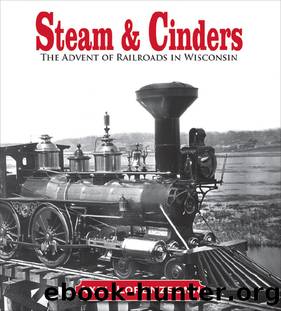
Records show that westbound freight trains carried merchandise, sundries, lumber, lath, shingles, pickets, coal, posts, salt, whiskey, apples, lime, stoves, brick, and livestock. Eastbound trains carried wheat but also corn, oats, barley, rye, flax seed, grass seed, potatoes, flour, pork, lard, potash, high wines, hogs, tobacco, hides, flax, broom corn, wool, sundries, butter, livestock, stone, lumber, packing barrels, linseed oil, mill feed, lead, and shot. During the year the Milwaukee & Mississippi enlarged its inventory of freight cars from 38 to 183 and added three locomotives to bring the total to eleven.14 The locomotives were all âeight-wheelers,â having four small wheels on a leading truck and four large wheels driven by the engine.
Much wood was needed as fuel to move the trains, and the company was always advertising for it. Farmers along the line cut trees and hauled them to collection points where âwood trainsâ would carry them to âwood stations.â There a single horse would be âplodding patiently in a circle at the end of a long sweepâ to turn a circular saw that cut the wood to length. When trains stopped to âwood up,â passengers who were in a hurry would help the crewmen load wood into the tender.15
The cost of running trains over the seventy-mile line in 1853 would total eighty-seven thousand dollars. Of this, fuel costs (in the form of wood contracts) composed 23 percent; station services 22 percent; repairs of the road 11 percent; repairs on locomotives 10 percent; and train services, repairs of cars, oil and waste, stationery and printing, taxes, and miscellaneous, the remaining 34 percent.16
Its line continuing to expand to the west, the company constructed a number of new buildings in 1853. In Milwaukee it built a large, two-story warehouse that allowed the transfer of freight between cars and lake vessels. Milwaukee also received a brick round house with seven locomotive stalls. New passenger and freight depots were built at Fulton, Stoughton, and Madison. The Milwaukee & Mississippi exhibited genuine concern for the safety of its passengers and employees, something lacking on most railroads of the 1850s. At the end of the year, Superintendent Brodhead reported:
Download
This site does not store any files on its server. We only index and link to content provided by other sites. Please contact the content providers to delete copyright contents if any and email us, we'll remove relevant links or contents immediately.
| Africa | Americas |
| Arctic & Antarctica | Asia |
| Australia & Oceania | Europe |
| Middle East | Russia |
| United States | World |
| Ancient Civilizations | Military |
| Historical Study & Educational Resources |
Cat's cradle by Kurt Vonnegut(15441)
Pimp by Iceberg Slim(14666)
4 3 2 1: A Novel by Paul Auster(12513)
Underground: A Human History of the Worlds Beneath Our Feet by Will Hunt(12145)
The Radium Girls by Kate Moore(12093)
Wiseguy by Nicholas Pileggi(5841)
The Fire Next Time by James Baldwin(5503)
Perfect Rhythm by Jae(5461)
American History Stories, Volume III (Yesterday's Classics) by Pratt Mara L(5337)
Paper Towns by Green John(5247)
Pale Blue Dot by Carl Sagan(5081)
A Higher Loyalty: Truth, Lies, and Leadership by James Comey(5017)
The Doomsday Machine by Daniel Ellsberg(4545)
The Mayflower and the Pilgrims' New World by Nathaniel Philbrick(4540)
Killers of the Flower Moon: The Osage Murders and the Birth of the FBI by David Grann(4488)
The Sympathizer by Viet Thanh Nguyen(4445)
Too Much and Not the Mood by Durga Chew-Bose(4386)
The Borden Murders by Sarah Miller(4381)
Sticky Fingers by Joe Hagan(4255)
